Fish sauce (nước mắm) is on almost every table in Vietnam, and Phu Quoc is the name most Vietnamese cooks look for on the bottle. The island has been making it for well over a century, and the big wooden barrel houses around Duong Dong are one of the few places where you can see it made the traditional way.
This guide is for travellers who want more than a souvenir: what you actually see at a factory, how to tell a good bottle from a cheap one, what it costs and the airline rules that catch a lot of people at check-in.
Quick facts about Phu Quoc fish sauce
- Made from: black anchovies (cá cơm) and sea salt. Nothing else in the best bottles.
- Fermentation: around 12 months in large wooden barrels, sometimes longer.
- Where to see it: family barrel houses in and around Duong Dong town, plus a few near An Thoi.
- Factory visit: usually free, 20 to 40 minutes, with tasting and a shop.
- Quality grade: shown as °N on the label; 30°N and above is high grade.
- Protected name: EU Protected Designation of Origin since 2012.
- Flying home: checked baggage only, sealed plastic bottles, airline limits apply.
What makes Phu Quoc fish sauce special?
Three things: the fish, the method and the protected name. The anchovies are caught in the waters around the island and salted on the boat, often within minutes of being caught, so they reach the barrels fresh. The sauce is then left to ferment slowly in wooden barrels instead of concrete tanks or plastic vats, and the first liquid drawn off is sold as the top grade.
In 2012 Phu Quoc fish sauce became the first Vietnamese product registered in the European Union as a Protected Designation of Origin, in the same group as Champagne or Parmigiano Reggiano. In practice it means that, in the EU, only sauce made on the island from local anchovies and salt can carry the name. In Vietnam itself you will still see plenty of bottles that say "Phu Quoc" in big letters and something else in the small print, which is why the label section below matters.
How Phu Quoc fish sauce is made
The process is simple on paper and slow in practice. This is the order you will see it explained at most barrel houses:
- Catch and salt. Black anchovies are mixed with coarse sea salt on the boat, roughly three parts fish to one part salt.
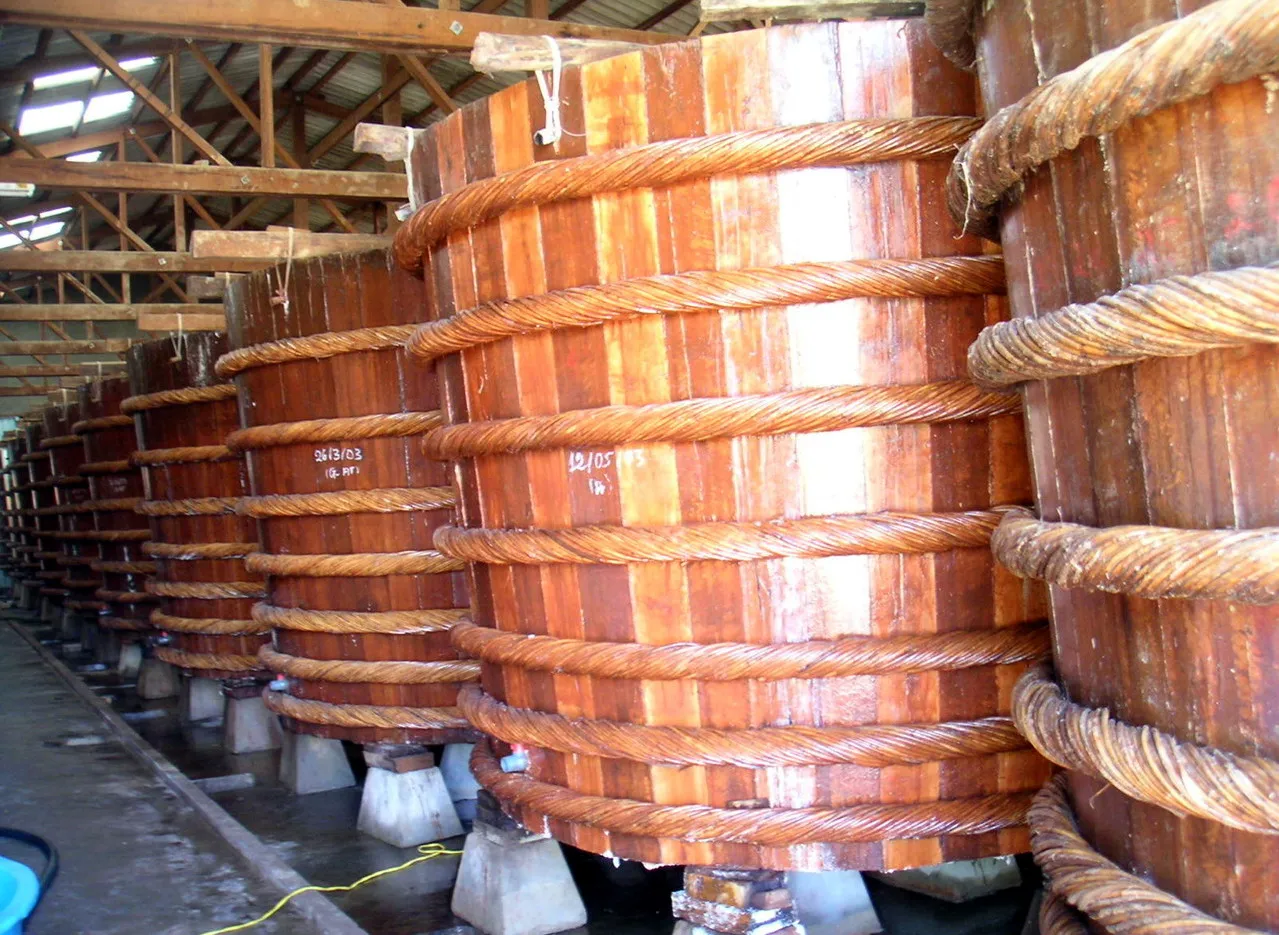
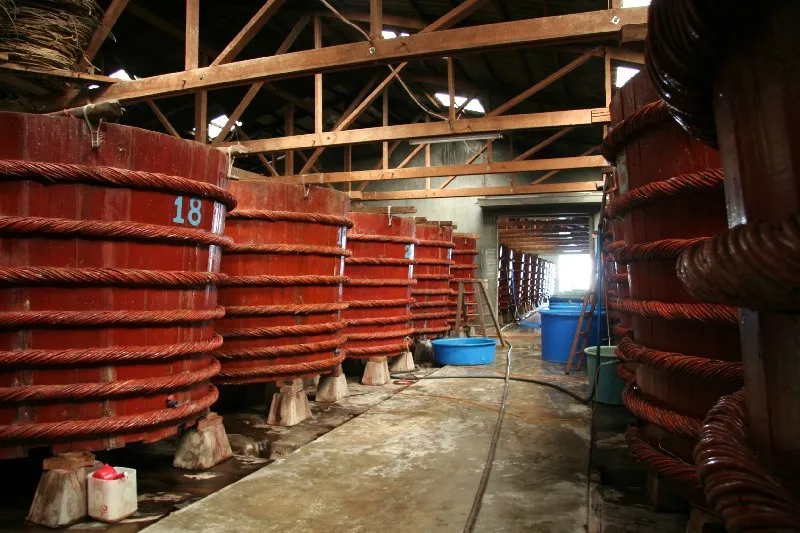
- Fill the barrels. The salted fish go into huge wooden barrels, each several metres around, bound with thick rope and set on concrete blocks. A single barrel holds many tonnes of fish.
- Ferment. The fish are pressed under a wooden lid with weights and left for around a year. In the first months the liquid is drained from a tap at the bottom and poured back over the top to keep the fermentation even.
- Draw the first press. The first clear, amber liquid that runs out is the richest grade (nước mắm nhĩ). Later runs, often with salt water added, become cheaper cooking grades.
- Rest and bottle. The sauce is left to settle, tested for protein level and bottled.

Visiting a fish sauce factory: what to expect
Most of the barrel houses are family businesses in and around Duong Dong, many of them along or near the river, with a few more towards An Thoi in the south. A typical visit looks like this:
- A short walk through the barrel room. Long rows of rope-bound barrels, each with a number and a date chalked on the side. Some barrel houses have hundreds of them.
- A quick explanation of the process, sometimes only in Vietnamese if you walk in on your own.
- Tasting of two or three grades, usually from a small spoon or with a piece of rice cracker.
- The shop at the end. Buying is optional, but this is where the visit is heading.
Entry is usually free and 20 to 40 minutes is enough. Most places open during the day, roughly from morning to late afternoon, but hours change from one barrel house to the next and are rarely published, so check on the day.
Going alone or with a guide
You can take a Grab to a barrel house in Duong Dong and walk in. The catch is that not every factory lets walk-in visitors into the barrel rooms, and without someone to translate you may only see the shop. Going with a guide or on a tour that already includes a factory stop is the easier option if you want the full explanation.
About the smell
It is strong, but most visitors find it less unpleasant than they feared: salty and slightly sweet, not rotten. It is strongest next to open barrels and it sticks to fabric, so wear clothes you do not mind and closed shoes, because floors are often wet and salty. Do not touch the barrels or lean on the taps.
How to read a Phu Quoc fish sauce label
Four things on the bottle tell you most of what you need to know:
- °N (độ đạm): the protein level. Around 25°N is everyday cooking grade, around 30°N and above is high grade, and first-press sauces can go above 40°N. Higher means richer and more expensive.
- Ingredients: the best bottles list only anchovies (cá cơm) and salt (muối). Water, sugar, MSG, preservatives or colouring mean a blended or cheaper product.
- Where it was made: look for a producer address on Phu Quoc, not just the words "Phu Quoc" on the front.
- Colour: good fish sauce is clear and reddish amber, not cloudy or very dark.
What to buy and how much it costs
Buying at a barrel house gives you the widest choice of grades and the chance to taste first. Local listings from 2026 put prices at roughly 100,000 to 200,000 VND per litre, depending on the protein level; check the price on the day. You will also find Phu Quoc fish sauce in supermarkets and on market stalls (see our night market guide for the current market), where it is easier to compare brands but harder to know how old the stock is.
- For cooking at home: 30°N to 35°N is a good balance of flavour and price.
- As a gift or for dipping sauces: a small bottle of first-press, 40°N or higher.
- Size: small bottles (250 to 500 ml) are easier to pack and fit airline limits.
- Packaging: ask for plastic bottles and a sealed travel box; many barrel houses pack for flights because they know the rules.
Want to try it before you buy? Almost every local dish uses it. Our Phu Quoc food guide lists what to order and where.
Taking fish sauce home on the plane
Fish sauce is the souvenir most likely to cause a problem at check-in. Vietnam Airlines publishes clear rules, which are a good guide for any flight:
- Not in hand luggage. The airline advises against strong-smelling foods in the cabin, and bottles over 100 ml would not pass security anyway.
- Checked baggage only, up to 3 litres or 3 kg per passenger.
- Plastic bottles only, with the lid taped to the bottle and no more than 95% full. Glass bottles and unsealed containers are not accepted.
- Pack the bottles in a foam box (the barrel houses usually sell them) and put that inside your suitcase.
- Small ATR72 propeller flights have different rules, and other airlines set their own. Check with your airline before you buy a lot.
Also check your home country's rules on bringing in food. For the airport itself, see our Phu Quoc airport guide.
How to combine a factory visit with the rest of the island
A fish sauce factory is a short stop, so it works best as part of a bigger day. Good pairings:
- Duong Dong town, the market and Dinh Cau, if you are visiting on your own.
- A pepper farm and a pearl farm, the island's other local products.
- Phu Quoc Prison, for the island's wartime history.
- Sao Beach for lunch and a swim.
- Ho Quoc Pagoda, the island's largest pagoda, with a view over the sea.
Our South-East Phu Quoc Tour puts these together in one day by road. It leaves around 9:00 and visits a sim wine farm, a cultured pearl farm, Phu Quoc Prison and a fish sauce production factory in the morning, stops at Sao Beach around midday, then continues to Ho Quoc Pagoda and a pepper farm, with the return to your hotel around 15:30. Times are approximate and can change with the weather. We'll confirm the final details before your booking.

South-East Phu Quoc Tour
A fish sauce factory, a pearl farm and a pepper farm, plus Sao Beach and Ho Quoc Pagoda, in one day by road with hotel pickup.
- From 690,000đ per adult
- About 6.5 hours
Also worth a look: Night Squid Fishing Tour, from 330,000đ.
FAQ
Can I visit a fish sauce factory in Phu Quoc?
Yes. Several family barrel houses in and around Duong Dong let visitors walk through the barrel rooms, taste and buy. Entry is usually free and a visit takes 20 to 40 minutes. Some factories do not open the barrel rooms to walk-in visitors, so going with a guide or a tour is easier.
What does °N mean on a bottle of Phu Quoc fish sauce?
°N is the protein (nitrogen) level. The higher the number, the richer the sauce. Around 25°N is everyday cooking grade, around 30°N and above is considered high grade, and the strongest first-press sauces go above 40°N.
Can I take Phu Quoc fish sauce on the plane?
Not in hand luggage. Vietnam Airlines allows up to 3 litres or 3 kg per passenger in checked baggage, in plastic bottles with the lid taped shut, no more than 95% full and packed in a foam box. Glass bottles are not accepted. Rules are different on small ATR72 flights and on other airlines, so check with your airline before you fly.
Does a fish sauce factory smell bad?
The smell is strong but not as bad as most people expect: salty and a little sweet rather than rotten. It is strongest right next to open barrels and tends to stick to clothes, so do not wear your best outfit.
Is Phu Quoc fish sauce protected?
Yes. Phu Quoc fish sauce was registered in the European Union as a Protected Designation of Origin in 2012, the first Vietnamese product to get that status. Only sauce made on the island from local anchovies and salt can use the name there.
Which tour includes a fish sauce factory?
Our South-East Phu Quoc Tour includes a fish sauce production factory in the morning, together with a pearl farm, Phu Quoc Prison, Sao Beach, Ho Quoc Pagoda and a pepper farm, in one day by road.
Photo credits (Wikimedia Commons): barrel house by ntt, CC BY-SA 3.0; salted anchovies by Frank Fox, CC BY-SA 4.0; barrel room by Stefan from Dresden, CC BY 2.0. Images resized and converted to WebP.