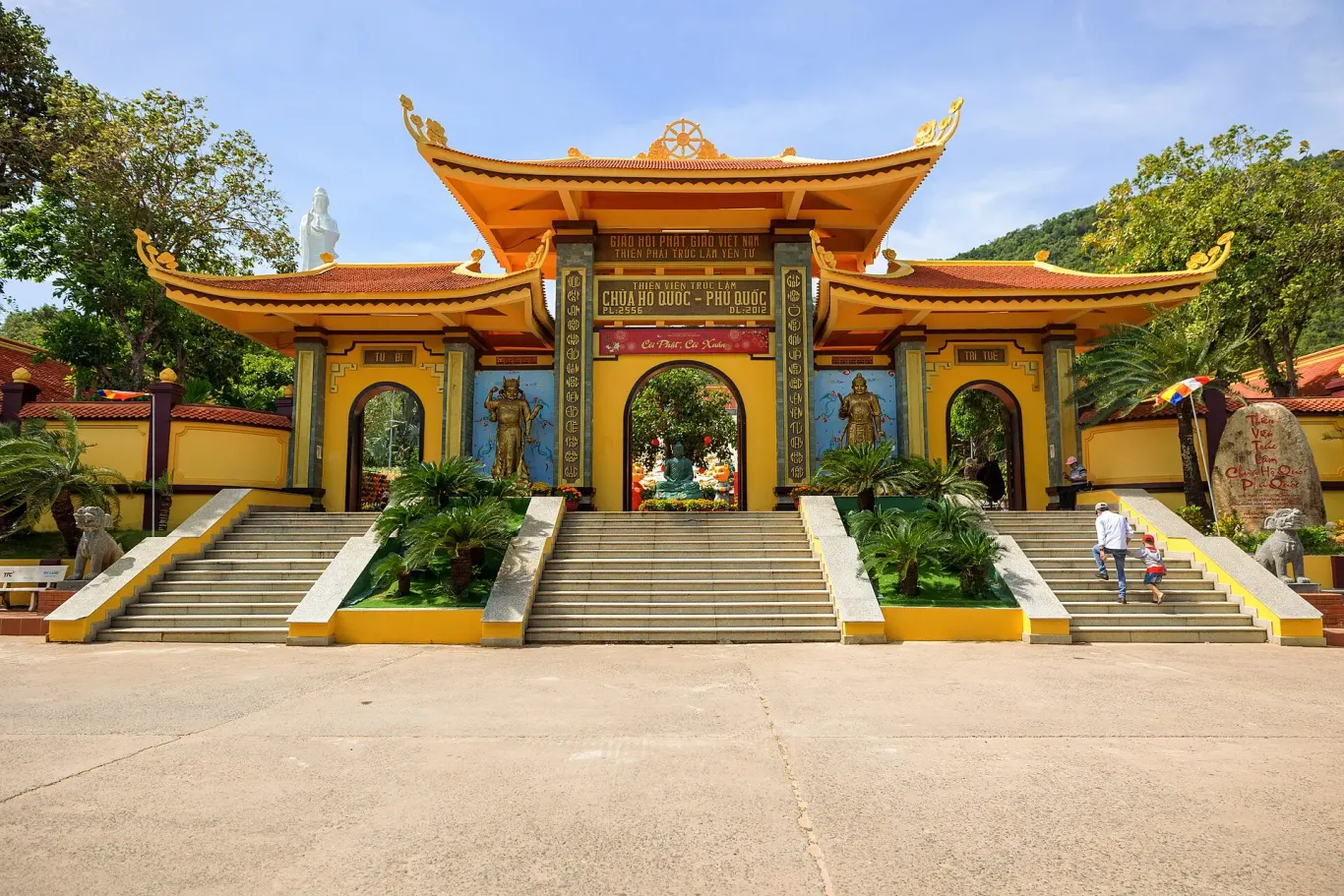
Ho Quoc Pagoda sits on a green hillside on Phu Quoc's south-east coast, with a long dragon staircase that drops towards the sea. It is the biggest Buddhist complex on the island and one of the few places where you get culture and a wide sea view in the same stop.
Most visitors arrive on the way to or from Sao Beach. This guide covers the practical side: how to get there, what to wear, what you will actually see, how long to stay and how to fit it into a south-east day without sitting in a taxi twice.
Quick facts about Ho Quoc Pagoda
- Vietnamese name: Thiền viện Trúc Lâm Hộ Quốc (often shortened to Chùa Hộ Quốc).
- Where: Suoi Lon area, south-east coast, between Duong Dong and An Thoi.
- Entrance fee: free (donation boxes on site).
- Hours: most listings give about 6:00 to 18:00, every day.
- Dress code: shoulders and knees covered; shoes off in the main hall.
- Time needed: 45 minutes to 1.5 hours.
- Nearby: Sao Beach and Khem Beach are around 15 minutes away.
What is Ho Quoc Pagoda?
Ho Quoc is a working Zen monastery of the Truc Lam school, the Vietnamese branch of Zen Buddhism. The gate carries the date 2012, the year it opened, so it is a modern complex rather than an old temple. It was built in the traditional style of the Ly and Tran dynasties, with curved tiled roofs and a lot of dark ironwood in the halls.
The grounds are large and laid out on a slope: a main gate at road level, a wide courtyard with a jade Buddha, long staircases lined with stone dragons, and the main hall at the top. A tall white statue of Guan Yin (Quan Am, the bodhisattva of compassion) stands on the hill next to it and can be seen from the road.
Monks live and practise here, so it is not a show-piece. That is part of the appeal: it is calm, clean and much quieter than the busy beaches nearby.

How to get to Ho Quoc Pagoda
The pagoda is on the east side of the island, off the coastal road that runs south towards Sao Beach and An Thoi. Most visitors go by car, scooter or with a tour:
- From Duong Dong or Long Beach: about 20 to 25 km, roughly 35 to 45 minutes by car or scooter. Grab and taxis go there without problem; for the way back, agree a waiting time with your driver or book the return in the app before you go in.
- From the airport: around 10 km, so it is an easy first or last stop if you have a few hours before a flight.
- From Sao Beach, Khem Beach or An Thoi: around 15 minutes. This is why most people visit it as part of a south-east day rather than as a separate trip.
If you are not used to riding a scooter in Vietnam, a car or a tour with transport is the simpler option.
Dress code and etiquette
This is the question most visitors forget until they are at the gate. Keep it simple:
- Cover your shoulders and knees. A T-shirt and long shorts, trousers or a long skirt are fine.
- If you are coming straight from the beach, carry a light scarf or sarong to put on.
- Take off your shoes and hat before stepping into the main hall.
- Speak quietly, especially near the halls where people are praying.
- Do not point your feet at the altars or climb on statues for photos.
- Ask before photographing monks or people praying.
What to see at Ho Quoc Pagoda
Walk from the bottom to the top and back; the order below follows the usual route.
The triple gate
The yellow three-arched gate with its curved orange roof is the classic first photo. Through the central arch you can already see the jade Buddha in the courtyard.
The jade Buddha and the dragon staircases
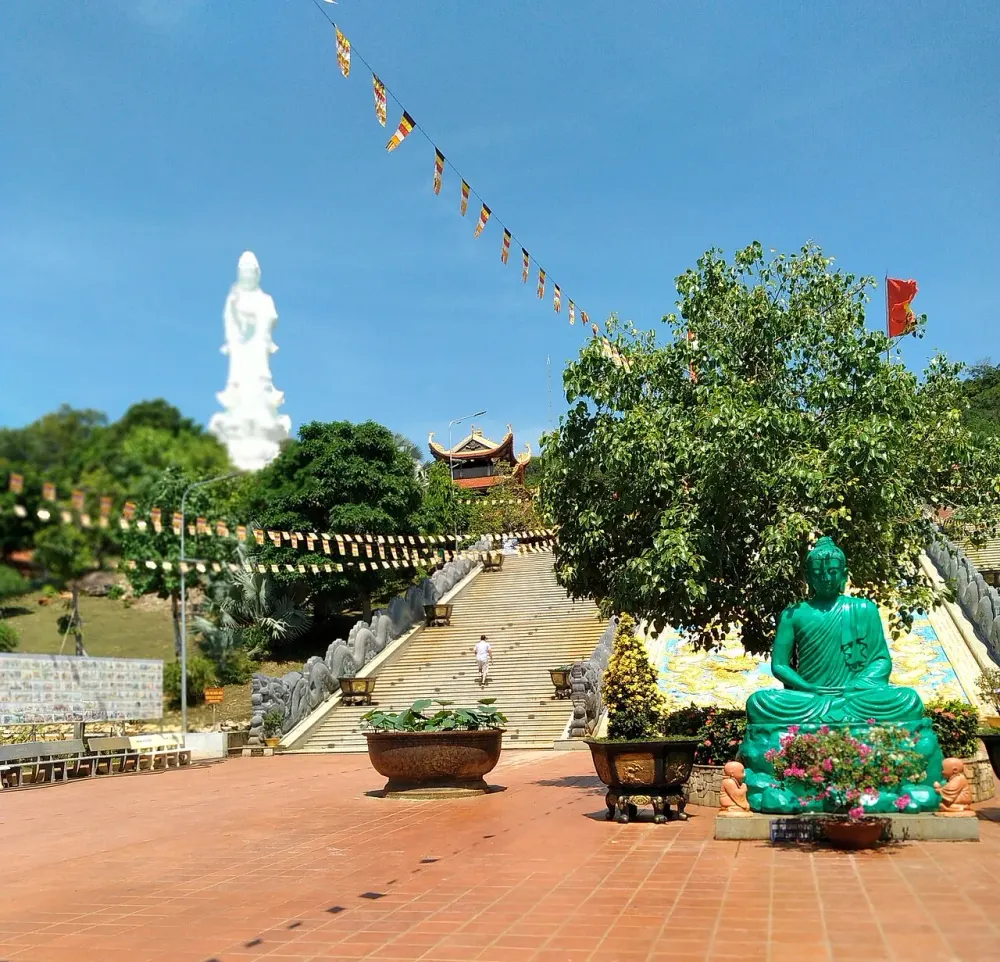
In the courtyard, a green seated Buddha sits under a large tree. Behind it, wide staircases lined with grey stone dragons lead up to the main hall. It is a long climb with no shade on the steps, so take it slowly in the heat.
The main hall
At the top, the main hall is built in dark wood with a richly carved interior. Leave your shoes outside. Beside it you will find the bell tower and the drum tower, both in the same traditional style.
The view back down to the sea
The best moment comes when you turn around. From the top of the stairs you look down over the golden dragon relief, the courtyard and the gate to the open sea. This is the view most people come for.

The Guan Yin statue
The white Guan Yin statue stands on a separate rise next to the main buildings. It is worth the short walk if you still have energy after the stairs.
Best time to visit
Time of day: early morning or late afternoon. The stairs and courtyards are open to the sun, and between about 11:00 and 14:00 the stone gets hot and the climb is tiring. The pagoda faces east over the sea, so early risers get the sunrise side of the view.
Season: the dry months, roughly November to April, give the clearest sea views. In the rainy season the visit still works, but the steps can be slippery and showers come quickly. See our best time to visit Phu Quoc guide for the full picture.
Festivals: on Buddhist holidays and around Lunar New Year (Tet) the pagoda is much busier with local families. It is a good time to see it in use, but expect crowds.
How to combine it with Sao Beach and the south-east
Ho Quoc Pagoda works best as one stop in a south-east day. Within a short drive you have:
- Sao Beach, the island's best-known white-sand beach, for lunch and a swim.
- Khem Beach, quieter and close by.
- Phu Quoc Prison, for the island's wartime history.
- Pepper farms, a fish sauce factory and a pearl farm along the way, for local products.
A good order is local stops in the morning, Sao Beach for lunch and a swim, then the pagoda in the afternoon. That is exactly how our South-East Phu Quoc Tour is planned: it leaves around 9:00, stops at Sao Beach around midday and reaches Ho Quoc Pagoda and a pepper farm in the early afternoon, with the return to your hotel at the end. Times are approximate and can change with the weather. We'll confirm the final details before your booking.
Practical tips
- Bring water and a hat. There is a lot of walking on open stairs.
- Wear shoes you can slip off easily for the main hall.
- Think about mobility. The site is built on a slope with many steps. Older travellers or anyone with knee problems can still enjoy the courtyard and gate area at the bottom.
- Bring small notes if you want to leave a donation.
- Check the time on the day. Hours are not officially published; plan to arrive well before 17:00.
- Choose your base with this in mind. If the south-east is a priority, see where to stay in Phu Quoc.

South-East Phu Quoc Tour
Ho Quoc Pagoda, Sao Beach and a pepper farm in one day by road, with hotel pickup and the return planned for you.
- From 690,000đ per adult
- About 6.5 hours
Also worth a look: 4 Islands & Cable Car Tour, from 1,300,000đ.
FAQ
Is there an entrance fee at Ho Quoc Pagoda?
No. Entry to Ho Quoc Pagoda is free. There are donation boxes if you want to leave something.
What are the opening hours of Ho Quoc Pagoda?
Most listings give roughly 6:00 to 18:00 every day, but it is a working monastery and hours are not officially published, so arrive well before late afternoon.
What should I wear to Ho Quoc Pagoda?
Cover your shoulders and knees. A T-shirt with long shorts or trousers is fine; a light scarf or sarong helps if you come straight from the beach. Take your shoes and hat off before entering the main hall.
How far is Ho Quoc Pagoda from Duong Dong?
About 20 to 25 km by road, or roughly 35 to 45 minutes by car or scooter. From Sao Beach or Khem Beach it is only around 15 minutes.
How long do you need at Ho Quoc Pagoda?
Around 45 minutes to 1.5 hours is enough to climb the stairs, see the main hall and the Guan Yin statue and enjoy the sea view without rushing.
Can I visit Ho Quoc Pagoda and Sao Beach on the same day?
Yes. Both are on the south-east side of the island, and our South-East Phu Quoc Tour includes Sao Beach, Ho Quoc Pagoda and a pepper farm in one day by road.
Photo credits (Wikimedia Commons): gate by Kevin Rutherford, CC BY-SA 2.0; Guan Yin statue and sea view by Sketyl, CC BY 2.0; jade Buddha by Phương Huy, CC BY-SA 4.0. Images resized and converted to WebP.